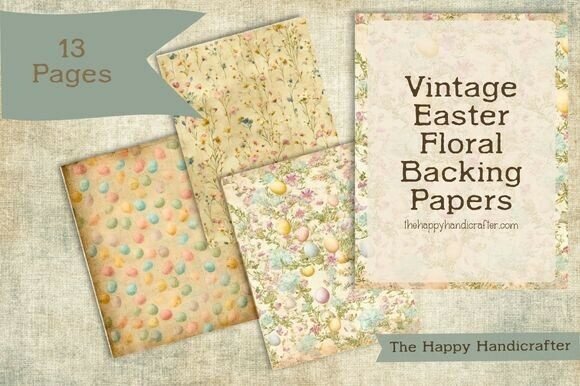
Vintage Easter Floral Backing Papers: A Practical Evaluation
In the realm of digital paper crafting, selecting the right background elements is often the most critical step in establishing the mood and cohesion of a project. Vintage Easter Floral Backing Papers represent a specific category of digital assets designed to evoke the aesthetic of early 20th-century spring ephemera. This collection typically includes thirteen high-resolution digital files featuring textured backgrounds inspired by antique botanical illustrations, faded greeting cards, and aged stationery. For crafters, scrapbookers, and junk journal enthusiasts, understanding the utility, limitations, and specific applications of these papers is essential before integrating them into a workflow.
Defining the Collection and Its Aesthetic
The primary characteristic of Vintage Easter Floral Backing Papers is their deliberate simulation of age and fragility. Unlike modern, solid-color digital papers or crisp vector graphics, these designs rely on visual complexity derived from distressed textures, watercolor washes, and soft focal points. The imagery generally incorporates delicate wildflowers, pastel-colored Easter eggs, botanical stems, and faint handwriting overlays. These elements are set against a palette that emphasizes muted, earthy tones such as sage green, dusty rose, robin’s egg blue, butter yellow, soft lavender, and antique cream.
This specific color theory serves a functional purpose in design. By utilizing desaturated pastels rather than neon or primary hues, the papers avoid competing with foreground elements like journaling text, photos, or die-cuts. The "vintage" aspect is achieved through digital manipulation that mimics the wear and tear of physical paper, including subtle grain, uneven edges, and faded ink effects. This creates a layered depth that is difficult to achieve with standard flat colors.
Reasons for Interest and Potential Applications
Crafters are often drawn to this type of digital resource when they seek to create projects with a nostalgic or historical feel. The appeal lies in the ability to instantly establish a seasonal theme without the need for physical sourcing of rare materials. For instance, creating a junk journal page dedicated to a family's history during the spring season requires a background that feels timeless. Vintage Easter Floral Backing Papers provide a ready-made canvas that aligns with themes of renewal, heritage, and gentle celebration.
These papers are particularly effective in several specific scenarios:
- Junk Journals and Travel Notebooks: The textured nature of the papers adds tactile interest to digital layouts that will be printed and bound. They serve as excellent base layers for collage work.
- Handmade Card Making: When printing at home, these backgrounds can be used to create custom cardstock, offering a unique look that mass-produced cardstock often lacks.
- Scrapbooking: They function well as album pages where photos are adhered directly over the design, allowing the floral borders and soft washes to frame memories.
- Digital Planning: In digital planners, these images can be used as monthly covers or decorative dividers to break up the monotony of grid lines and white space.
Benefits and Tradeoffs
One of the primary benefits of using a curated set like this is consistency. Because all thirteen papers share a unified color palette and texture style, they ensure that a multi-page project maintains visual harmony. This eliminates the common pitfall of mixing disparate digital assets that clash in tone or saturation. Furthermore, the inclusion of high-resolution JPG files ensures that the prints retain clarity even when enlarged for larger format scrapbook pages.
However, there are tradeoffs to consider. The very feature that defines these papers—their busy, textured appearance—can sometimes hinder readability if not managed correctly. Placing large blocks of black text directly over a section with dense floral patterns or faded handwriting may result in poor legibility. Users must be prepared to utilize text boxes with semi-transparent backgrounds or place text in the negative space of the design.
Additionally, while the "vintage" look is desirable for many, it may not suit every project. If a crafter is aiming for a bold, modern, or minimalist aesthetic, the soft, washed-out nature of these papers might appear too subdued or cluttered. The reliance on a specific pastel palette also limits versatility; these papers are unlikely to blend seamlessly into projects requiring vibrant neons, stark blacks and whites, or deep jewel tones.
Situations Where Alternatives May Be Better
While Vintage Easter Floral Backing Papers are excellent for their intended niche, they are not a universal solution. Crafters working on projects that require high-contrast photography should consider solid or gradient backgrounds instead. A photo with complex details may get lost against a textured floral backdrop, whereas a clean, neutral background would allow the image to stand out.
Similarly, for children's activity books or educational materials where clarity and engagement are paramount, the subtle, faded aesthetic of vintage papers might be too understated. Brighter, more defined illustrations often capture attention more effectively in these contexts. Furthermore, if the goal is to create a series of documents that need to be photocopied frequently in an office setting, the intricate textures and low-contrast colors of these papers may not reproduce well on standard laser printers, resulting in muddy or indistinct copies.
Practical Decision-Making Insights
When deciding whether to integrate this collection into your creative toolkit, evaluate your current inventory and project goals. If you already possess a robust library of solid colors and geometric patterns but lack options for seasonal, narrative-driven projects, this set fills a specific gap. It is particularly valuable for those who prefer to print their own supplies to save money or customize sizes, rather than purchasing pre-cut paper packs.
Consider the technical requirements of your output. Ensure your printer is capable of handling the specific color profile required to render the sage greens and dusty roses accurately. Standard inkjet printers may struggle to replicate the exact depth of the "antique cream" tones without calibration, potentially shifting the hue toward a warmer or cooler shade than intended. Testing a single sheet before committing to a full project is a prudent step.
Ultimately, the value of Vintage Easter Floral Backing Papers lies in their ability to transport a viewer to a specific time and feeling. They are a tool for storytelling, providing a visual language of nostalgia and springtime tranquility. By understanding their strengths in layering and thematic consistency, as well as their limitations regarding contrast and color range, crafters can make informed decisions about how best to utilize them. Whether for a personal junk journal or a commercial stationery design, these papers offer a distinct aesthetic that, when applied thoughtfully, enhances the overall quality of the final piece.