Sewing Era Hand Lettered Black White: A Practical Evaluation for Designers
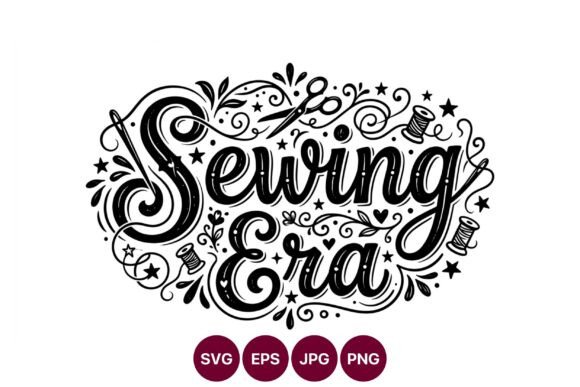
In the realm of digital crafting and textile design, the choice of graphic assets often dictates the final aesthetic and technical success of a project. The Sewing Era Hand Lettered Black White vector collection represents a specific niche within this market, offering a high-contrast, monochromatic approach to typographic design. This resource features the phrase "Sewing Era" rendered in a hand-lettered style, surrounded by iconic imagery such as spools, scissors, hearts, stars, and decorative swirls. For designers, makers, and small business owners, understanding the distinct characteristics of this asset is crucial before integrating it into commercial or personal workflows.
This article examines the utility, format, and stylistic implications of the Sewing Era Hand Lettered Black White artwork. It explores how this specific vector set compares to alternative design resources, evaluates its strengths and limitations, and provides a framework for deciding when this tool fits best within a broader creative strategy.
Defining the Visual Identity and Format
The core appeal of the Sewing Era Hand Lettered Black White lies in its deliberate simplicity and versatility. Unlike full-color illustrations that may clash with specific fabric palettes or branding guidelines, this black-and-white vector art relies on high contrast to define its shapes. The typography mimics the organic flow of hand-drawn lettering, providing a human touch that contrasts effectively with the geometric precision of the surrounding elements like stars and spools.
Technically, the availability of the artwork in multiple formats—specifically SVG, PNG, JPG, and EPS—addresses various stages of the production pipeline. The inclusion of SVG (Scalable Vector Graphics) and EPS (Encapsulated PostScript) files is particularly significant for professional applications. These vector formats ensure that the intricate details of the hand-lettered text and decorative swirls remain sharp regardless of the scale. Whether the design is being resized for a tiny embroidery patch or blown up for a large vinyl banner, the resolution does not degrade.
Conversely, the raster formats (PNG and JPG) offer immediate usability for web graphics or social media content where vector editing is unnecessary. The ZIP folder delivery method consolidates these options, streamlining the workflow for users who require flexibility across different software platforms.
Comparing Vector Assets with Raster Alternatives
When evaluating design resources, a primary decision point is the choice between vector and raster images. Many free online clipart libraries offer sewing-themed graphics exclusively in JPEG or PNG formats. While these may suffice for low-resolution screen use, they present significant limitations for physical production.
The Sewing Era Hand Lettered Black White stands out because it prioritizes vector integrity. In a comparison scenario, a designer attempting to use a standard JPEG for a laser cutter or Cricut machine would likely encounter jagged edges or pixelation upon scaling. The vector nature of the Sewing Era files eliminates this risk. The mathematical paths defining the letters and icons allow for infinite scalability without quality loss.
Furthermore, the editable nature of SVG and EPS files offers a strategic advantage over static raster images. With raster alternatives, changing the color of a heart or star requires complex masking or photo-editing techniques. With the Sewing Era vector set, a user can easily isolate individual elements—such as the scissors or the decorative swirls—and alter their stroke weight or fill color directly within vector editing software. This adaptability makes the resource more robust for custom projects than pre-colored, non-editable alternatives.
Stylistic Tradeoffs: Minimalism vs. Detail
While the high-contrast black and white aesthetic is a strength, it also introduces specific tradeoffs that users must consider. The monochromatic scheme ensures the design remains neutral, making it compatible with virtually any background color or pattern. However, this neutrality means the artwork lacks inherent texture or depth that might be found in watercolor-style or 3D-rendered sewing illustrations.
For projects requiring a vintage, textured look, the clean lines of the Sewing Era Hand Lettered Black White might feel too stark without additional post-processing. Users may need to apply textures, overlays, or shading effects manually to achieve a softer, more nostalgic vibe. In contrast, if the goal is modern minimalism, bold logos, or crisp vinyl decals, the unadorned black lines are ideal.
Additionally, the "hand-lettered" style carries its own connotations. It suggests craftsmanship and personalization, which aligns well with boutique brands and handmade markets. However, it may not suit projects demanding strict corporate uniformity or highly structured geometric designs. When comparing this to sans-serif, block-style typography often found in industrial design kits, the Sewing Era option leans heavily into the artisanal category. It is a stylistic choice that signals warmth and tradition rather than efficiency and automation.
Use Cases and Application Scenarios
The versatility of the file formats included in the download makes the Sewing Era Hand Lettered Black White suitable for a wide array of applications, though some use cases benefit more than others.
- Textile Printing: The high-contrast vectors are excellent for screen printing or direct-to-garment (DTG) printing. The clear separation between the black ink and the white background simplifies the separation process for print shops.
- Craft Cutting Machines: For users of Silhouette Cameo or Cricut machines, the SVG files are essential. They allow for precise cutting of vinyl, heat transfer material, or paper. The decorative swirls and stars can be cut individually to create layered die-cut projects.
- Digital Branding: The PNG and JPG versions serve well for social media profiles, website headers, or digital invitations where vector editing is not required.
- Embroidery Digitizing: While not an embroidery file (DST/EXP) itself, the clean vector lines provide an excellent base for digitizers to trace and convert into stitch patterns, ensuring the final embroidery retains the legibility of the hand lettering.
However, there are scenarios where this specific asset may not be the optimal choice. If a project requires a seamless pattern repeat, the standalone nature of this composition limits its utility without significant manipulation. Similarly, if a brand identity relies on complex gradients or photorealistic elements, the flat, line-art style of the Sewing Era design would require substantial reworking to fit the visual language.
Decision Factors for Selecting This Resource
Before committing to the Sewing Era Hand Lettered Black White, potential users should weigh several practical factors against their specific project requirements.
Technical Proficiency: While the PNG and JPG files are accessible to beginners, maximizing the value of the SVG and EPS files requires familiarity with vector editing software such as Adobe Illustrator, CorelDRAW, or Inkscape. Users who lack access to these tools or the skills to manipulate them may find the vector advantages less relevant, though the raster files still offer utility.
Color Strategy: The black and white foundation is a double-edged sword. It offers maximum flexibility for coloring but requires the user to do the work. If a designer needs a fully colored, finished illustration immediately, this resource will require an extra step. Conversely, if the design system demands a flexible master template, the monochrome start is a significant benefit.
Licensing and Commercial Use: As with any digital asset, understanding the licensing terms is critical. While the prompt describes the product's features, users must verify whether the license permits unlimited commercial reproduction, modifications, or resale of derivative works. Comparing this against royalty-free stock photography or subscription-based design platforms helps determine the long-term cost-effectiveness.
Conclusion: Weighing Value Against Needs
The Sewing Era Hand Lettered Black White is a specialized tool designed for clarity, scalability, and stylistic consistency. Its strength lies in the combination of a timeless monochromatic palette and the technical precision of vector formats. For professionals creating logos, apparel graphics, or craft templates, the ability to scale the artwork without losing detail is a decisive advantage over lower-quality raster alternatives.
However, it is not a universal solution. Projects requiring complex textures, pre-applied color schemes, or seamless patterns may find the limitations of this specific style restrictive. The decision to utilize this resource should hinge on the need for editable, high-contrast line art that balances a handcrafted aesthetic with digital precision. By understanding these nuances, designers can make informed choices that align with their production capabilities and aesthetic goals, ensuring the final output meets both technical standards and creative vision.